


Breaking-News

होम Dr Jagdish Gandhi
Dr Jagdish Gandhi
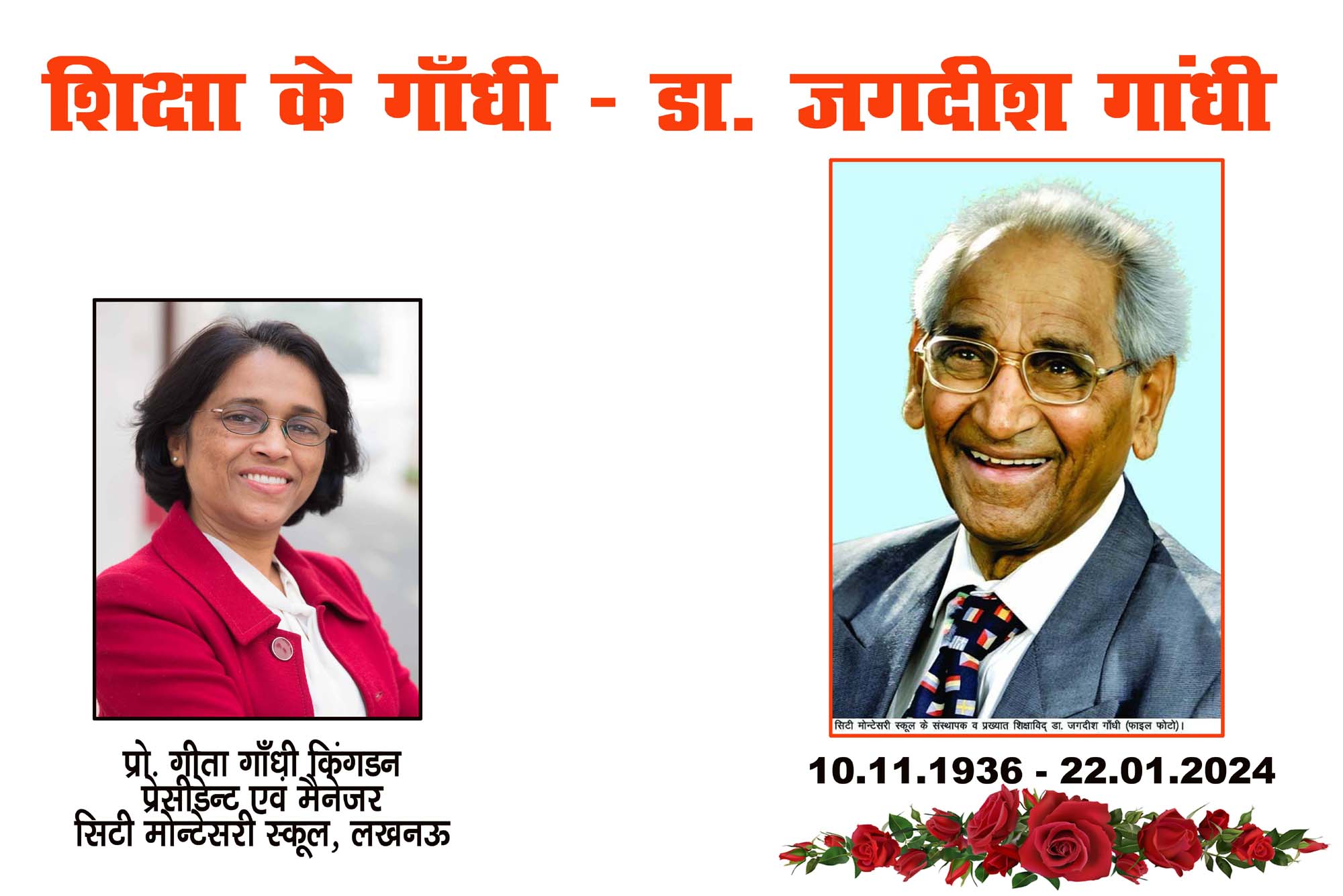
10.11.1936 — 22.01.2024
Dr Jagdish Gandhi, an iconic figure in the field of education, tireless advocate for global peace, and founder of the largest school in the world - City Montessori School (CMS) - passed away on January 22 at the age of 87.
Jagdish Gandhi, born Jagdish Chandra Agrawal on November 10, 1936, in Barasauli, Sikandra Rao, Aligarh, Uttar Pradesh, India, dedicated his life to serve humanity through is unique contribution to the field of education, which touched the lives of so many in the city of Lucknow and beyond.
Dr Gandhi and his wife, Bharti Gandhi, founded CMS in 1959 with just Rs 300 in borrowed capital and 5 children. His visionary leadership and holistic approach to education transformed the institution into the world's largest school with 62,000 students today, earning a Guinness World Record and the UNESCO Prize for Peace Education in 2002.
His philosophy of education expended beyond academics. His emphasis on values, ethics, the unity of humankind, and peace permeated every aspect of CMS' curriculum. In pursuit of this goal, he organized 20 international educational events annually to bring children together from various countries and different parts of India for interpersonal, multilingual and cross-cultural exchanges. He also organized annual conferences on gender equality and on inter-faith harmony in multi-religious societies for thought leaders.
A Baha'i by religion, he was inspired by the Baha'i teachings about the oneness of humanity and the need for a world government which drove him to create Lucknow's flagship world renowned event; the International Conference of Chief Justices of the World. Every year, continually for 24 years, he invited Supreme Court judges, Heads of State, thought leaders, and peace promotes from all corners of the planet to Lucknow in order to build a climate of global opinion in favour of creating an effective global governance structure with a world parliament, a world executive and a world court of justice to bring about multilateral solutions to supranational problems.
He was considered a person who faced challenges head-on. He never saw language, ethnicity or nationality as barriers, he understood them as opportunities to generate new knowledge and as a means to see human beings - in all diversity - as part of a single organism.
Dr. Gandhi was well-known for his steadfastness and determination. In the period of 1958-59 he was elected President of the Lucknow University Students Union. In this capacity, he invited the then PM Jawaharlal Nehru to inaugurate the Student Union hall. Against all odds and the skepticism of many, PM Jawaharlal Nehru accepted the invitation and went to Lucknow's University to inaugurate the new building.
Before dedicating all his efforts to the field of education, Dr Gandhi's commitment to changing the life of society drove in to serve as a Member of the Legislative Assembly (MLA) in Uttar Pradesh from 1969 to 1974. Early on in his promising political career, Dr Gandhi understood that being successful in politics would mean making compromises - to some degree - with the values and ethics that he held so dear to his heart. This greatly troubled him and, with the help of his young family and the teachings of the Baha'i Faith, he decided that his remaining life would be dedicated to the service of God through the education of children.
Such a life of hard work and unconditional service resulted in many accolades and awards given to him, such as honorary doctorates from universities in five different countries, the Yash Bharti award of the Government of Uttar Pradesh, or the Dalai Lama's Hope of Humanity Award, among others.
Dr Gandhi's rich legacy is defined by his unwavering dedication to transforming the field of education and promoting unity and peace on a global scale. His life's work and service will continue to impact generations to come all around the world.
(Prof. Geeta Gandhi Kingdon)
President and Manager
City Montessori School, Lucknow

-advertisement-
(Last 14 days)
Leave A comment
महत्वपूर्ण सूचना -
भारत सरकार की नई आईटी पॉलिसी के तहत किसी भी विषय/ व्यक्ति विशेष, समुदाय, धर्म तथा देश के विरुद्ध आपत्तिजनक टिप्पणी दंडनीय अपराध है। इस प्रकार की टिप्पणी पर कानूनी कार्रवाई (सजा या अर्थदंड अथवा दोनों) का प्रावधान है। अत: इस फोरम में भेजे गए किसी भी टिप्पणी की जिम्मेदारी पूर्णत: लेखक की होगी।